Couldn't load pickup availability
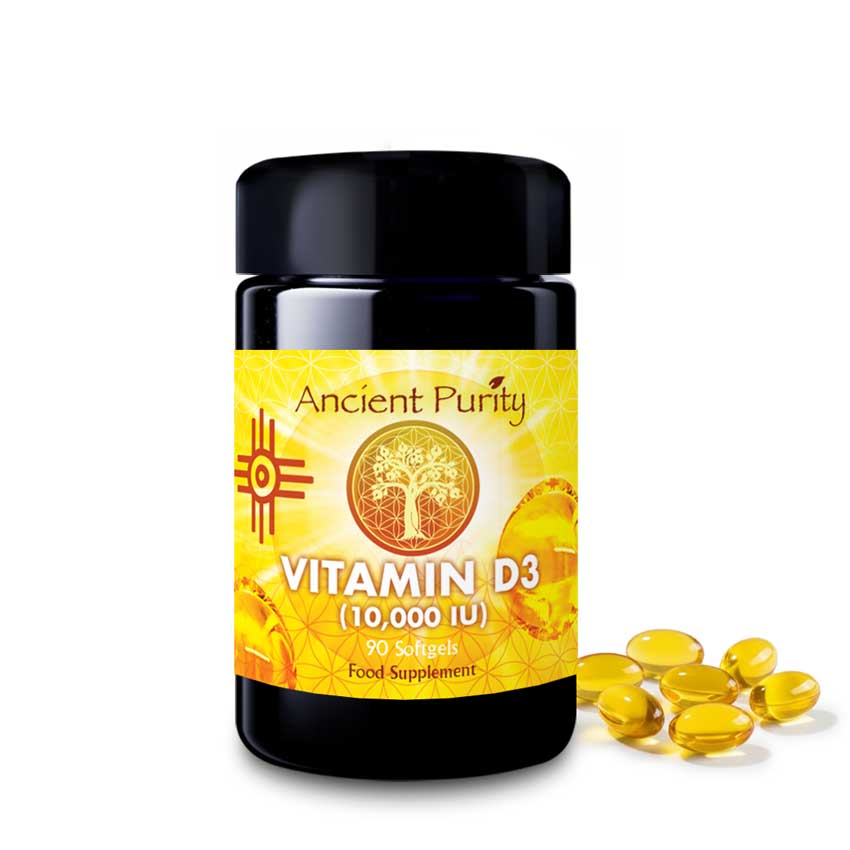
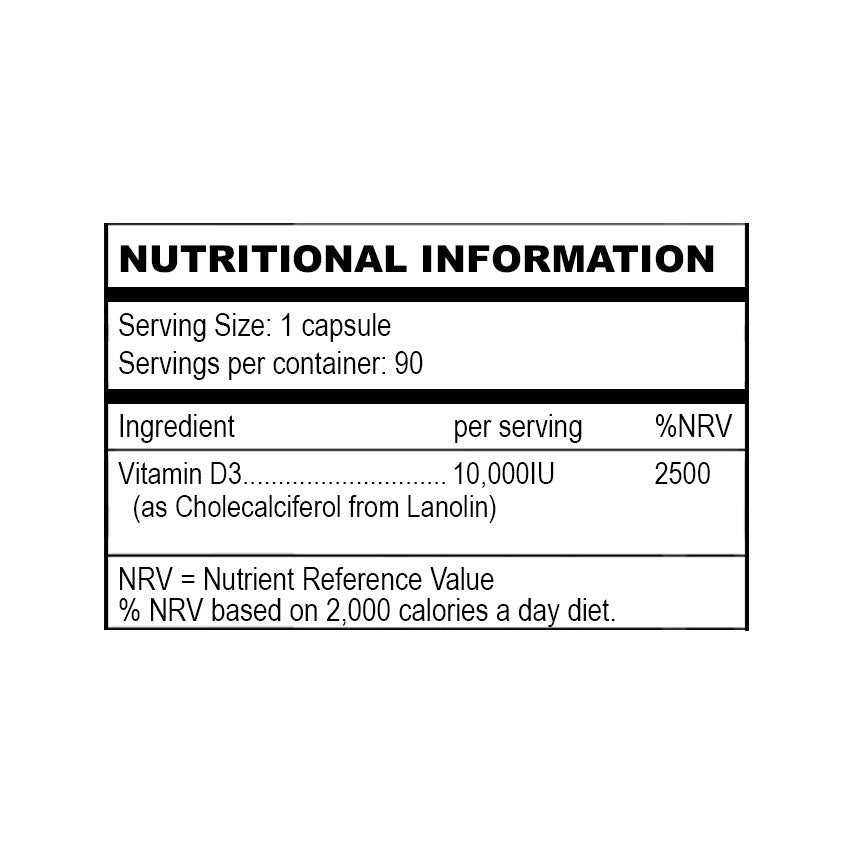
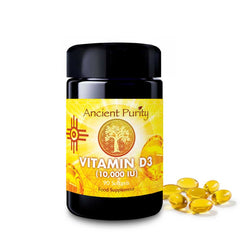
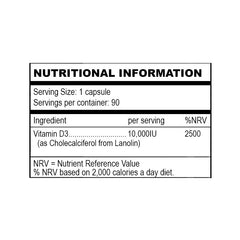
Ancient Purity Vitamin D3 10,000iu with Olive Oil Synergy for Maximum Absorption | Ultra-Potent, Fully Bioavailable, High-Strength Vitamin D3
Vitamin D3 is not merely a vitamin, it is a precursor hormone that orchestrates a symphony of critical physiological functions. From maintaining healthy bones, muscles, and teeth, to supporting immune defence, cardiovascular integrity, cognitive clarity, and mood stability, D3 is the silent cornerstone of human vitality. Modern lifestyles, insufficient sun exposure, indoor living, and low dietary intake, have left the majority of adults deficient. Ancient Purity’s high-strength 10,000iu softgels ensure your body has what it needs for optimal hormone signalling, longevity, and peak cellular function.
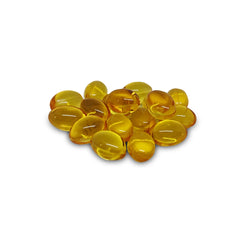
Ancient Purity Vitamin D3 is designed for maximum assimilation. Vitamin D3 is fat-soluble, so we combine it with premium Olive Oil, a natural carrier that enhances uptake at the cellular level. Each softgel is stored in Miron “Dark Violet” Glass, protecting it from UV light and oxidation, preserving potency for months. Unlike generic D3 supplements, these ultra-clean softgels contain only measured, therapeutic D3, nothing else. Every element of this product is engineered for efficiency, safety, and superior results.
Think of Vitamin D3 as a bridge between ancient natural wisdom and modern science. Historically, humans thrived with abundant sunlight, naturally producing D3 to regulate countless bodily processes. Today, deficiencies are rampant, affecting mood, immunity, energy, and longevity. Taking Ancient Purity Vitamin D3 10,000iu is a conscious step to reclaim what modern life has deprived you of. With this supplement, you’re not just supporting your bones, you’re enhancing your body’s full spectrum of vitality, resilience, and long-term health.
Q: Can you give me some guidance and advice on how to take Vitamin D3?
A: Remember Vitamin D is actually a hormone. It was wrongly classified originally as a vitamin. Like any supplement but particularly with hormones, one should get the dose right. Your doctor can test your Vitamin D levels which should be done before supplementation to see if you have a deficiency, then again one month after supplementation to see if the supplemental dose is correct or needs adjustment. It is vital that enough Magnesium is consumed when supplementing with Vitamin D. Similarly one must ensure adequate intake of Vitamin K2 from a food source such as pasture fed dairy, meat and eggs, natural or a supplement, the best being Vitamin K2 Mk7. Many experts suggest between 1000iu to 10,000iu per day.
Ancient Purity's Thoughts on Dosage... Studies have shown that 30 minutes in sunlight could be as much as 10,000 - 20,000 iu's of Vitamin D. I myself really love the sun! And If I could, I would spend as much hours in the sun as possible. If I would have worked in my garden for 8 hours that could be 160,000 - 320,000 iu's of Vitamin D. Now we all know that the majority of us humans feel happier and better in the sun. However, the sun is very different from a softgel capsule. The question I have never really had answered is how much can we take? It seems we all vary on what we need given our ethnicity and skin type. Lots of health experts have an idea. A doctor might prescribe 600iu's.
There is a difference between taking enough to not be deficient and enough to thrive. Ultimately you have to make the choice of how much you want to take because I believe there is no exact science on how much an individual needs.
Dr Mercola recommends, at the time of writing, that optimal levels are 50 to 70nmo/l and that particularly severe conditions may require 70 to 100nmo/l. He suggests that 10,000iu's might be an appropriate dose but insists that you ask your Dr for a blood test before beginning vitamin D supplementation, which is our recommendation too.
Dr Gonzalez famous for his remarkable cure rates believes that patients suffering from the serious condition in which some of the body's cells grow uncontrollably and spread to other parts of the body may need less than Dr Mercola recommends and his protocol is more like Dr Grant's opinion below.
Dr William Grant who has extensively studied Vitamin D estimates that for the average European, a blood level of Vitamin D is around 54nmol/L. Upping levels to 100 to 125nmol/L reduces mortality in a whole range of conditions. According to Dr Grant "It is important for optimal health to keep Vitamin D blood levels above 100 nmol/L. That is difficult in the UK due to the high latitude and frequent cloud cover and modern lifestyle. It takes about 3,000 to 5,000iu's a day for most people to reach this level. We asked him what he takes: "I take 50,000iu of vitamin D3 every two weeks (that's about 3,500iu a day); my blood level is 168 nmol/L, and in the summer I am now shooting for 15-20 minutes of sunlight near solar noon with shirt off on clear days.
Important, Get your Vitamin D levels checked by the doctor (FREE IN UK) before using a vitamin D supplement and retest after a few months.
Each persons need for Vitamin D is individual. We're all different in our ability to make Vitamin D so it's difficult to assess individual needs, given variations in sunlight exposure, skin colour, diet, lifestyle and complicating factors such as liver conditions or how many Vitamin D receptors are actually expressing and active. Following correct sun exposure one should remember that Vitamin D will take 48hrs to be fully absorbed, if you shower after correct sun exposure, remember that scrubbing with soap will diminish the Vitamin D, however just showering with water will not. You can then use soap on the essential areas like the groin and under arms while using water on the rest, this will give you the maximum benefit from you time in the sun.
Q: Can you explain Vitamin D levels how to get them checked and what it means?
A: The Vitamin D level is the concentration of 25(OH)D in your blood. The serum 25(OH)D concentration is accepted as the nutritional biomarker of Vitamin D sufficiency. Vitamin D levels are higher in summer/autumn, and lower in winter/spring. The Vitamin D level reflects both sun exposure and Vitamin D intake.
It is the marker of Vitamin D availability to tissues, including the immune system. Individuals vary in their Vitamin D levels and in their response to efforts to increase these levels. A simple blood test can determine your current Vitamin D level. To check your Vitamin D level, ask your health care provider for a 25(OH)D blood test. Your health care provider can then advise you on whether you need to increase your Vitamin D level.
Q: Is Vitamin D a Vitamin or a Hormone?
A: Although it’s called a Vitamin, Vitamin D is really a hormone and not actually a vitamin. Vitamins cannot be produced by our bodies. We get them from dietary sources, whereas Vitamin D is made in your body. It’s your body’s only source of calcitriol (activated Vitamin D), the most potent steroid hormone in the body.
Q: What does Vitamin D do?
A: Like all steroid hormones, Vitamin D is involved in making hundreds of enzymes and proteins, which are crucial for preserving health and preventing disease. It has the ability to interact and affect more than 2,000 genes in the body. It enhances muscle strength and builds bone. It has anti-inflammatory effects and bolsters the immune system. It helps the action of insulin and has anti-bad cells activity. This is why Vitamin D deficiency has been linked with so many of the health issues of modern society. Because of its vast array of benefits, maintaining optimal levels of Vitamin D is essential for your health.
Q: Where else do I get Vitamin D from?
A: Only about 10% of your Vitamin D comes from diet, so it is nearly impossible to get adequate amounts of Vitamin D from your diet. The only 2 reliable sources of vitamin D are the sun and supplements like Ancient Purity’s Softgels. Sunlight exposure is the only reliable way to generate Vitamin D in your own body. Vitamin D is produced by your skin in response to exposure to ultraviolet radiation from the sun. In fact, this is such an efficient system that most of us make 20,000 units of Vitamin D after only 20 minutes of summer sun without suntan lotion. That’s 100 times more than the government recommends per day!
There must be a good reason why we make so much in so little time. But these rays cannot penetrate glass to generate Vitamin D in your skin, so you don’t generate Vitamin D when sitting behind a glass window, whether in your car or at home. Also sunscreens, even weak ones, almost completely block your body’s ability to generate Vitamin D. The other reliable source is supplements. Most important is that you take vitamin D3, (cholecalciferol) the active form of Vitamin D. Do not take vitamin D2 as it is not as biologically active and effective, and nor as safe as vitamin D3. And taking the right amount is crucial. Most doctors tend to under dose. The current recommendations from the Food and Nutrition Board of the U.S. Institute of Medicine: from 200 to 600 IU/day depending on one’s age, are way too low. These values were originally chosen because they were found to prevent bone softening issues.
Q: How much sunshine do you need?
A: All living things need sun, the key is balance. Too much sun exposure can cause melanoma and skin ageing, while too little creates an inadequate production of Vitamin D. The amount needed depends on the season, time of day, where you live, skin pigmentation and other factors. As a general rule, if you are not Vitamin D deficient, about 20 minutes a day in the spring, summer and fall on your face and arms or legs without sunscreen is adequate. It doesn’t matter which part of the body you expose to the sun. Many people want to protect their face, so just don’t put sunscreen on the other exposed parts for those 20 minutes.
If you live north of 37 degrees latitude (approximately a line drawn horizontally connecting Norfolk, Virginia to San Francisco, California) sunlight is not sufficient to create Vitamin D in your skin in the winter months, even if you are sitting in the sun in a bathing suit on a warm January day! The further you live from the equator, the longer exposure you need to the sun in order to generate Vitamin D
Q: Can I take cod liver oil to get my Vitamin D?
A: Although Cod liver oil contains a fair amount of Vitamin D, it also contains high amounts of vitamin A. Vitamin A antagonises the action of Vitamin D and can be toxic at high levels.
Q: What are other food sources of Vitamin D?
A: Fatty wild fish like mackerel, salmon, halibut, tuna, sardines and herring, fortified milk, orange juice and cereal, dried Shitake mushrooms and egg yolks. To get adequate amounts of Vitamin D from food, you would have to eat at least 5 servings of salmon a day or drink 20 cups of fortified milk.
Q: My doctor prescribed Drisdol, 50,000 IU per week. What is it?
A: Drisdol is a prescription of 50,000 IU tablets of vitamin D2 or ergocalciferol. Ergocalciferol is not Vitamin D but it is similar. D2 is not normally found in humans and most studies show it does not raise 25(OH)D levels as well as (cholecalciferol or vit D3) does. If you are Vitamin D deficient, the best thing to do, is to take Vitamin D3
Q: Why using tanning beds to get my Vitamin D?
A: We personally like them.
Q: Do the capsules need to be refrigerated?
A: No.
Q: What's The Difference Between Vitamin D2 and Vitamin D3?
A: Two different forms of Vitamin D are used in supplements and fortified foods. Vitamin D2, also called ergocalciferol, is manufactured through the ultraviolet irradiation of a substance called ergosterol that comes from yeast. Vitamin D2 is vegan. Vitamin D3, also called cholecalciferol, is made by the ultraviolet irradiation of a substance derived from sheep's wool.
Some research suggests that Vitamin D2 and Vitamin D3 are absorbed equally well, although other studies suggest that Vitamin D3 is better absorbed. If you are treated for a Vitamin D deficiency, you may find that your health care provider recommends taking a higher dose of Vitamin D2 than of Vitamin D3 to compensate for possible differences in absorption. This is an area of active research that we will continue to follow.
Q: Is Vitamin D3 recommended for breast-fed babies?
A: Breast milk is the ideal food for infants. Human milk, however, contains little Vitamin D. If a nursing mother is Vitamin D-deficient, her breast milk will be even lower in Vitamin D than usual. To prevent Vitamin D deficiency in breast-fed babies, the American Academy of Pediatrics recommends that breast-fed babies be given a 400 IU/day Vitamin D supplement beginning within the first few days after birth. Another possible way to prevent Vitamin D deficiency in a breast-fed infant is for the mother to take a Vitamin D supplement daily containing up to 4,000 IU of Vitamin D3.
High-dose Vitamin D supplements, used by the lactating mother, have been shown to markedly increase breast milk Vitamin D content. While there is some possibility that a baby will be able to make adequate Vitamin D following sunlight exposure, there are many factors that interfere with Vitamin D production (skin pigmentation, pollution, kind of season, amount of clothing, location, and sunscreen). This is why supplemental Vitamin D is recommended.
Q: Your Vitamin D3 capsules are 10'000 IU yet I’ve found smaller amount D3 capsules that are larger than yours, please explain?
A: This is simply down to the other ingredients. Some companies might put more sunflower oil or olive oil to fatten up the capsules.
Q: Why is Olive Oil included in Ancient Purity Vitamin D3 softgels?
A: Vitamin D3 is fat soluble, meaning it requires dietary fat for proper absorption. The inclusion of high quality Olive Oil ensures Vitamin D3 is delivered in a form your body can immediately assimilate. Olive Oil is a stable, longevity supporting fat that enhances bioavailability, reduces oxidation and mirrors how Vitamin D is absorbed naturally from food and sunlight.
Q: Should Vitamin D3 be taken with food or on an empty stomach?
A: Vitamin D3 is best taken with a meal containing some fat. Although Olive Oil is already included in the softgel to support absorption, taking it with food further enhances uptake and mimics natural physiology.
Q: Is it better to take Vitamin D3 in the morning or evening?
A: Most people prefer taking Vitamin D3 earlier in the day as it aligns with natural sun exposure and circadian rhythms. Some individuals find taking it late at night can feel stimulating. Consistency matters more than timing, so choose a time you will stick to daily.
Q: Why is Vitamin D3 considered essential for immune health?
A: Vitamin D receptors are present on immune cells throughout the body. Vitamin D helps regulate immune responses, supports normal inflammatory balance and plays a role in defending against seasonal and environmental challenges. Low Vitamin D levels are consistently associated with weakened immune resilience.
Q: Does Vitamin D3 support mood and mental wellbeing?
A: Yes. Vitamin D influences neurotransmitters and brain regions involved in mood regulation. Deficiency has been linked with low mood and seasonal emotional changes. Optimising Vitamin D levels is often associated with improved sense of wellbeing and mental clarity.
Q: Is 10,000 IU of Vitamin D3 safe for daily use?
A: For many adults, 10,000 IU daily is considered within safe upper limits when taken responsibly and monitored. Safety depends on individual factors such as baseline Vitamin D levels, body weight, sun exposure, genetics and cofactor intake. Blood testing is strongly recommended.
Q: What happens if I accidentally take too much Vitamin D3?
A: Vitamin D toxicity is rare and typically occurs only with extremely high doses taken long term without cofactors. Symptoms are related to calcium imbalance rather than Vitamin D itself. Ensuring adequate Magnesium and Vitamin K2 intake greatly reduces risk.
Q: Why is Magnesium essential when taking Vitamin D3?
A: Magnesium is required to activate Vitamin D in the body. Without sufficient Magnesium, Vitamin D may remain inactive and can increase the risk of imbalance. This is why Magnesium deficiency symptoms can appear when Vitamin D is supplemented without adequate Magnesium intake.
Q: Why is Vitamin K2 important alongside Vitamin D3?
A: Vitamin D increases calcium absorption, while Vitamin K2 directs calcium to bones and teeth and away from soft tissues and arteries. Together they form a critical safety and effectiveness partnership for bone, heart and vascular health.
Q: Can I take Vitamin D3 long term?
A: Yes. Vitamin D is a hormone your body is designed to produce daily from sunlight. Long term supplementation is often necessary in modern lifestyles, particularly in northern latitudes, provided levels are monitored and cofactors are respected.
Q: Does Vitamin D3 support heart and cardiovascular health?
A: Vitamin D plays a role in vascular function, blood pressure regulation and inflammatory balance. Adequate levels are associated with healthier cardiovascular outcomes, especially when combined with Vitamin K2 and Magnesium.
Q: Is Vitamin D3 suitable for people with darker skin tones?
A: Individuals with darker skin produce less Vitamin D from sunlight due to higher melanin levels. Supplementation is often especially important in these populations to maintain optimal levels.
Q: Is Vitamin D3 important as we age?
A: Yes. Ageing reduces the skin’s ability to synthesise Vitamin D from sunlight. Older adults are at higher risk of deficiency, making supplementation increasingly important for bone density, muscle strength, immune health and longevity.
Q: Why is Ancient Purity Vitamin D3 stored in Miron glass?
A: Miron dark violet glass protects contents from light frequencies that degrade sensitive nutrients. It preserves potency, freshness and energetic integrity far better than plastic or clear glass, especially for fat soluble compounds like Vitamin D3.
Q: Why are your softgels smaller than other brands with the same IU?
A: Ancient Purity focuses on potency, purity and efficiency rather than filler oils. Many larger capsules contain excessive carrier oils. Smaller softgels indicate a more concentrated, intelligently formulated product.
Q: Can I take Vitamin D3 while fasting?
A: Yes, although absorption is optimal when taken with food. The Olive Oil included in the softgel allows flexibility for those following intermittent fasting or time restricted eating.
Q: Is Vitamin D3 beneficial for muscle strength and recovery?
A: Vitamin D supports neuromuscular function, muscle contraction and strength. Deficiency is linked to weakness and increased injury risk, particularly in older adults and athletes.
Q: Does Vitamin D3 support longevity?
A: Optimal Vitamin D levels are associated with reduced all cause mortality and healthier ageing. Its role in gene regulation, immune balance, inflammation control and hormonal signalling makes it a foundational longevity nutrient.
Q: What works best with Vitamin D3?
A: It's obvious to say Vitamin K, I will add that and explain why but I also think MSM Organic Sulphur is synergistic with D3 and then the actual ingredient Olive Oil, that also works with Vitamin D3.
Vitamin D3 10,000iu + Vitamin K1 & K2 Complex
Our Vitamin K1 and K2 supplement completes the Vitamin D pathway by directing calcium where it belongs. Vitamin D increases calcium absorption, while Vitamin K2 activates proteins that guide calcium into bones and teeth and away from arteries. This pairing supports skeletal strength, cardiovascular health, and long term safety when using higher strength Vitamin D3.
Vitamin D3 10,000iu + Olive Oil
is not just a carrier but a functional cofactor. Vitamin D3 requires fat for absorption, and olive oil provides a clean, stable lipid environment that enhances intestinal uptake and hormonal conversion. This mirrors how Vitamin D is absorbed naturally from food and sunlight exposure, making the delivery more physiological.
Vitamin D3 10,000iu + MSM Organic Sulphur
MSM Organic Sulphur supports connective tissue integrity, detoxification pathways, and cellular flexibility. Sulphur is involved in enzyme activity and structural protein formation, complementing Vitamin D’s role in bone, muscle, and immune regulation. Together they support structural resilience and recovery at a cellular level.
See FAQs for more guidance on use.
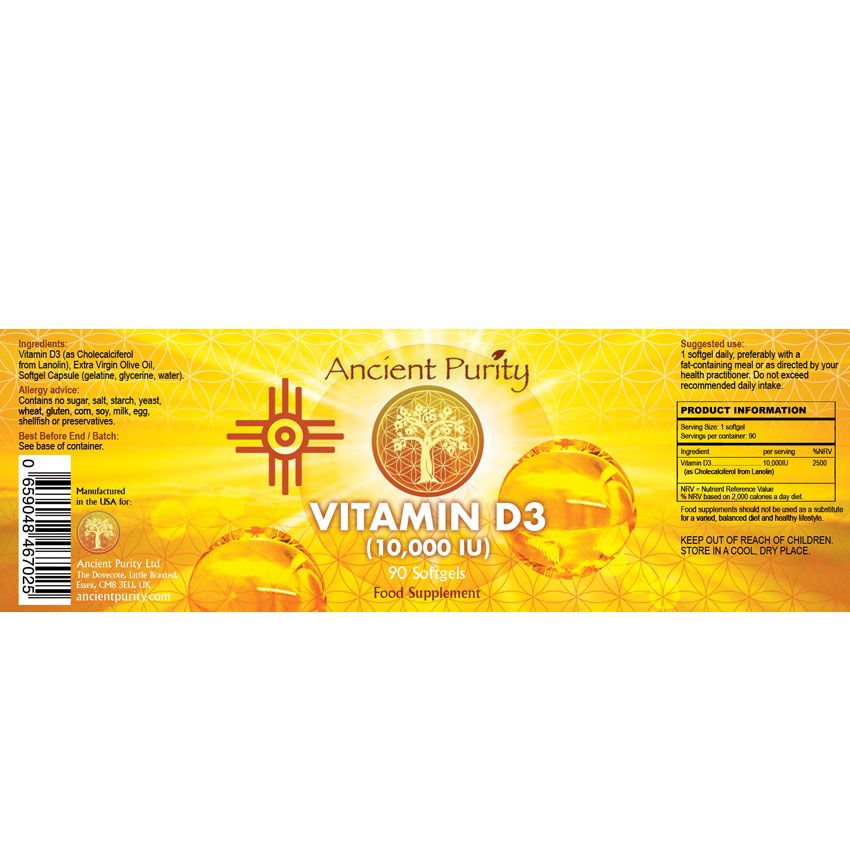
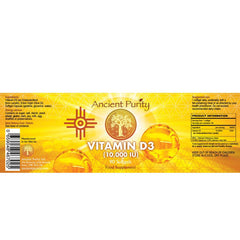
Other ingredients: Softgel capsule - Gelatine, Vegetable Glycerin water.
FREE FROM: Yeast, wheat, gluten, milk, egg, fish, shellfish or nut tree ingredients.
Produced in a facility that processes other ingredients containing these allergens.
Thanks for subscribing!
This email has been registered!