Currency
Currency


Couldn't load pickup availability
Pinhole Eye Glasses | Natural Vision Training, Sharper Focus, Eye Relaxation & Visual Clarity
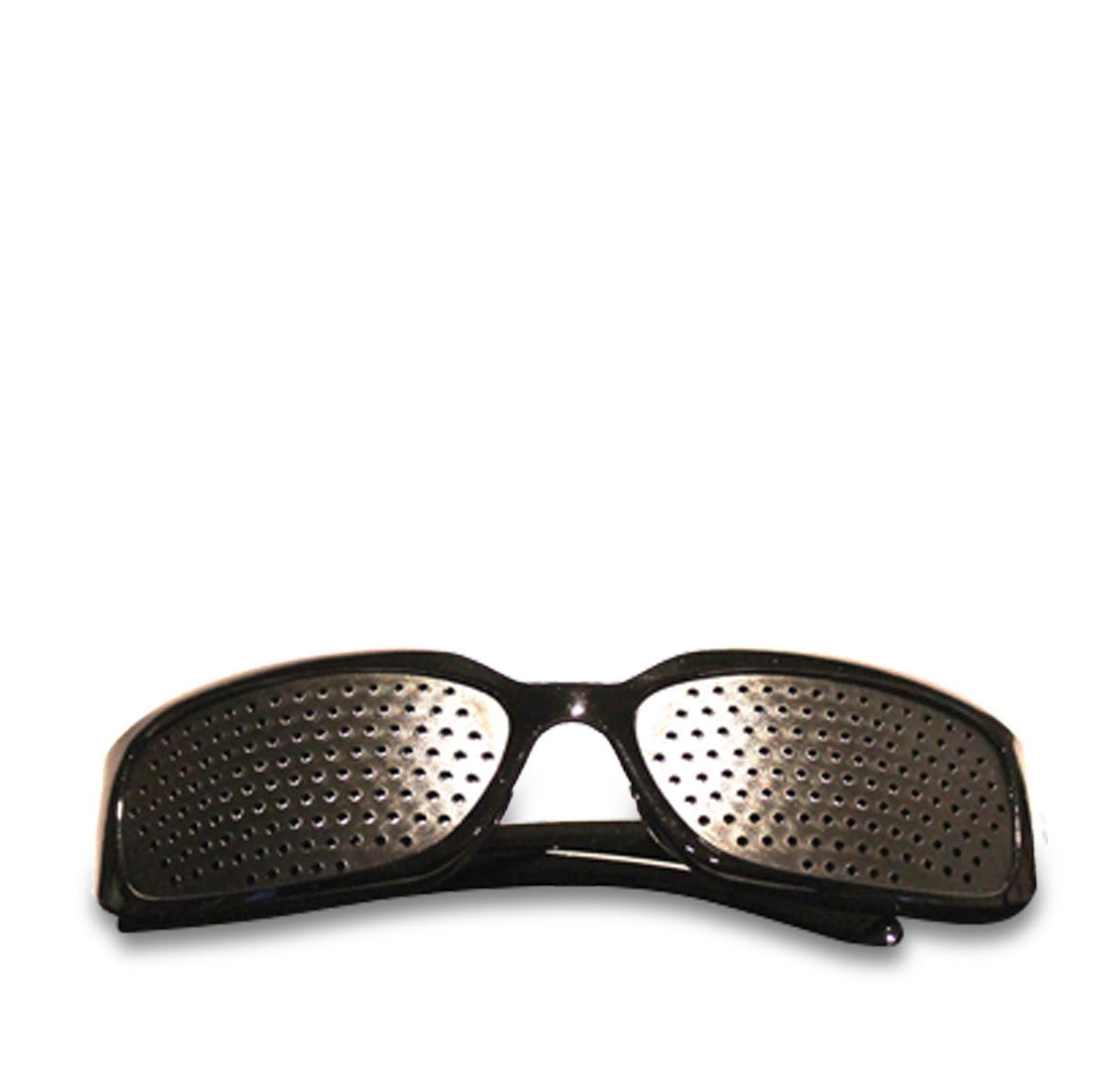
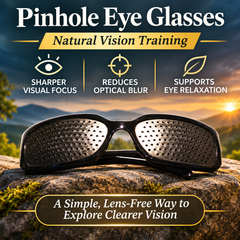
Pinhole Eye Glasses offer a fascinating approach to visual clarity based on a simple principle of optical science. Rather than using conventional corrective lenses, these distinctive glasses feature numerous tiny apertures that control the amount and direction of light entering the eyes. By blocking peripheral light rays that contribute to blurred images, the pinhole effect increases depth of focus and can produce an immediate improvement in perceived sharpness for individuals with certain refractive errors. This optical principle has been recognised for centuries and remains a useful demonstration of how light, focus and visual perception interact. For those interested in natural vision practices, visual awareness and understanding how the eyes process light, Pinhole Eye Glasses provide an intriguing way to experience clearer vision without conventional lenses.
Unlike prescription glasses, which use specially shaped lenses to bend incoming light, Pinhole Eye Glasses rely entirely on their physical aperture design. Their multiple small openings create a narrower pathway for light, helping reduce the blur associated with imperfect focusing. The design is straightforward, lightweight and completely free from electronic components. They can be explored during short, stationary visual exercises or controlled reading activities, particularly by individuals interested in optical training techniques and visual experimentation. Although the pinhole effect can temporarily sharpen vision, it does not permanently correct refractive errors or strengthen the eye muscles, and the reduced light and restricted field of vision make these glasses unsuitable for driving or moving around.
For anyone curious about natural vision techniques, optical performance and the science of sharper focus, Pinhole Eye Glasses offer a practical and affordable introduction to the pinhole principle. Their uncomplicated design makes it easy to experience the relationship between aperture size, light transmission and visual sharpness firsthand. Whether exploring visual clarity, incorporating short vision-focused activities into a daily routine or simply discovering an alternative optical concept, Pinhole Eye Glasses combine timeless optical science with a simple, reusable design — an interesting addition to any vision-conscious lifestyle.
Q: What is the origin of Pinhole Glasses?
A: It is not known who invented the pinhole glasses, but the scientific principles of pinhole effects were discovered many centuries ago. Pinhole glasses are widely sold in America, Europe and Australia as substitutes to prescription glasses since the 1950’s at least. The basic optical principles of the pinhole are commented on in Chinese texts from the fifth century BC. Chinese writers had discovered by experiments that light travels in straight lines. The philosopher Mo Tsu was the first – to our knowledge – to record the formation of an inverted image with a pinhole or screen. Aristotle (fourth century BC) comments on pinhole image formation in his work Problems. d. Sir David Brewster, a Scottish scientist, was one of the first to make pinhole photographs, in the 1850s.
Q: How long do we need to wear them to experience vision improvement?
A: It is not the length of time wearing them to achieve vision improvement but reducing or eliminating the root cause of vision challenges – stress and strain in the visual system, minimise the use of prescription glasses helps.
Q: How do I know my vision has improved?
A: The world has become clearer, and your existing pair of glasses feels over-powered and may even cause a headache. You can also use a Snellen Eye Chart to measure your vision improvement. You should consider using your previous pair of lowered-powered glasses or have the lenses stepped-down.
Q: How do Pinhole Eye Glasses improve visual clarity without prescription lenses?
A: Pinhole Eye Glasses use hundreds of tiny apertures to control the direction of light entering the eyes. By blocking peripheral light rays, they reduce optical blur and increase depth of focus, allowing objects to appear sharper without conventional corrective lenses. This optical effect can be particularly noticeable in people with short-sightedness, long-sightedness or astigmatism.
Q: Can Pinhole Eye Glasses naturally improve eyesight over time?
A: Pinhole Eye Glasses can provide an immediate, temporary improvement in visual sharpness by reducing the amount of unfocused light reaching the retina. Although they are popular in natural vision training, scientific evidence has not established that regular use permanently improves eyesight or reverses refractive errors. Their principal benefit comes from the optical pinhole effect.
Q: What is the science behind the pinhole effect?
A: The pinhole effect is a well-established optical phenomenon in which a small aperture restricts incoming light to a narrower range of angles. This reduces the size of the blurred image formed on the retina and increases depth of focus. The same principle is used in ophthalmology to help distinguish refractive errors from other causes of reduced visual acuity.
Q: Can Pinhole Eye Glasses help with short-sightedness (Myopia)?
A: Yes, Pinhole Eye Glasses can temporarily improve visual clarity in people with Myopia by reducing the blur caused when light focuses in front of the retina. The small apertures help create a sharper retinal image without changing the physical shape of the eye. They do not, however, reverse Myopia or prevent its progression.
Q: Are Pinhole Eye Glasses useful for long-sightedness (Hyperopia)?
A: Pinhole Eye Glasses can temporarily improve focus for some people with Hyperopia by increasing depth of focus and reducing optical blur. This can make certain near or distant objects appear clearer, depending on the individual's prescription and visual condition.
Q: Can Pinhole Eye Glasses improve vision affected by Astigmatism?
A: Astigmatism occurs when the cornea or lens has an irregular curvature, causing light to focus unevenly. Pinhole Eye Glasses restrict peripheral light rays, reducing some of the blur associated with this uneven focusing. Although the resulting image can appear sharper, the glasses do not change the curvature of the cornea or permanently correct Astigmatism.
Q: Do Pinhole Eye Glasses exercise or strengthen the eye muscles?
A: Pinhole Eye Glasses change how light enters the eye rather than directly exercising the muscles responsible for focusing. They can be incorporated into visual awareness activities, but there is no convincing clinical evidence that wearing them strengthens the eye muscles or improves accommodation. Their immediate effects are optical rather than muscular.
Q: Can Pinhole Eye Glasses help with age-related reading difficulties (Presbyopia)?
A: Presbyopia develops as the eye's natural lens gradually loses flexibility, making close-up focusing more difficult. By increasing depth of focus, Pinhole Eye Glasses can temporarily make nearby text appear clearer for some individuals. However, they cannot restore the lens's lost flexibility or reverse age-related changes in focusing ability.
Q: Can Pinhole Eye Glasses help reduce digital eye strain?
A: Pinhole Eye Glasses can be used during short, stationary visual activities, but they have not been proven to reduce digital eye strain. Prolonged screen use commonly causes discomfort through reduced blinking, dryness and sustained near focusing. Regular screen breaks, comfortable lighting and appropriate prescription correction remain more reliable approaches to maintaining visual comfort.
Q: Why do objects sometimes appear sharper immediately when wearing Pinhole Eye Glasses?
A: The improvement occurs because the apertures reduce the diameter of the blur circles formed on the retina. This increases depth of focus, allowing objects at different distances to appear more clearly defined. The effect can happen almost instantly because it depends on the physical behaviour of light rather than gradual changes within the eye.
Q: Can Pinhole Eye Glasses help people who struggle to focus at different distances?
A: The increased depth of focus created by the pinhole effect can make objects at different distances appear sharper without requiring the same degree of precise optical focusing. However, this does not improve the eye's underlying ability to change focus between near and distant objects.
Q: Are Pinhole Eye Glasses suitable for natural vision training and the Bates Method?
A: Pinhole Eye Glasses are sometimes included in natural vision programmes inspired by the Bates Method and other alternative approaches to eyesight. They provide a practical demonstration of optical clarity and can be incorporated into visual awareness exercises. However, there is insufficient evidence that these programmes or pinhole glasses permanently correct refractive errors.
Q: How long should Pinhole Eye Glasses be worn each day?
A: There is no scientifically established daily wearing duration that produces lasting improvements in eyesight. Short sessions of a few minutes during stationary activities are a reasonable way to experience the optical effect. Extended wear can become uncomfortable because the apertures reduce incoming light and restrict peripheral vision.
Q: Can Pinhole Eye Glasses replace prescription glasses or contact lenses?
A: Pinhole Eye Glasses can temporarily sharpen vision for some individuals, but they are not a practical replacement for properly prescribed glasses or contact lenses. They reduce brightness, restrict peripheral vision and can interfere with normal visual activities. Their main value is demonstrating the pinhole effect rather than providing comprehensive everyday vision correction.
Q: Do Pinhole Eye Glasses help with night vision?
A: No. Pinhole Eye Glasses reduce the amount of light reaching the retina, making them unsuitable for dimly lit environments or night-time activities. Although smaller apertures can improve optical sharpness in sufficient lighting, they can make vision substantially darker when available light is limited.
Q: Can Pinhole Eye Glasses be used while reading or working at a computer?
A: They can be explored during short reading or computer-based activities in good lighting, provided the user remains stationary. Some people experience temporary improvements in text sharpness, while others find the restricted field of vision and reduced brightness uncomfortable. They are not established as a treatment for computer vision syndrome.
Q: Are Pinhole Eye Glasses suitable for driving, walking or exercising?
A: No. The small apertures restrict peripheral vision, reduce brightness and can interfere with depth perception and awareness of moving objects. Pinhole Eye Glasses should only be used during safe, stationary activities and must not be worn while driving, cycling or navigating potentially hazardous environments.
Q: Why are Pinhole Eye Glasses used in professional eye examinations?
A: Eye care professionals use the pinhole test to investigate whether reduced visual acuity is primarily caused by a refractive error. If vision becomes noticeably sharper when looking through a small aperture, this suggests that optical focusing contributes to the blurred vision. The test is a useful diagnostic aid, although it does not replace a comprehensive eye examination.
Q: Can Pinhole Eye Glasses improve vision in people with cataracts?
A: Pinhole testing can sometimes improve visual acuity when refractive error contributes to blurred vision, but cataracts involve clouding of the eye's natural lens. Pinhole Eye Glasses cannot remove this clouding or reverse cataract development. The effect varies depending on the location and severity of the lens opacity.
Q: What makes Pinhole Eye Glasses different from conventional glasses?
A: Conventional glasses use precisely shaped lenses to refract light and correct specific focusing errors. Pinhole Eye Glasses contain no corrective lenses; instead, they use multiple small apertures to restrict incoming light and increase depth of focus. This makes them a simple, reusable optical tool for exploring visual clarity without prescription lens technology.
Q: Why choose Pinhole Eye Glasses for a natural vision routine?
A: Pinhole Eye Glasses provide an accessible way to experience one of the fundamental principles of optical science. Their lightweight, lens-free design allows users to explore temporary changes in visual sharpness, depth of focus and visual perception. For anyone interested in natural vision techniques and understanding how the eyes process light, they offer a straightforward and fascinating optical experience.
NOTE: While Pinhole glasses may be useful for people who are both near- and far-sighted, they are not recommended for people with over 6 diopters of myopia.
Thanks for subscribing!
This email has been registered!