Currency
Currency


Couldn't load pickup availability
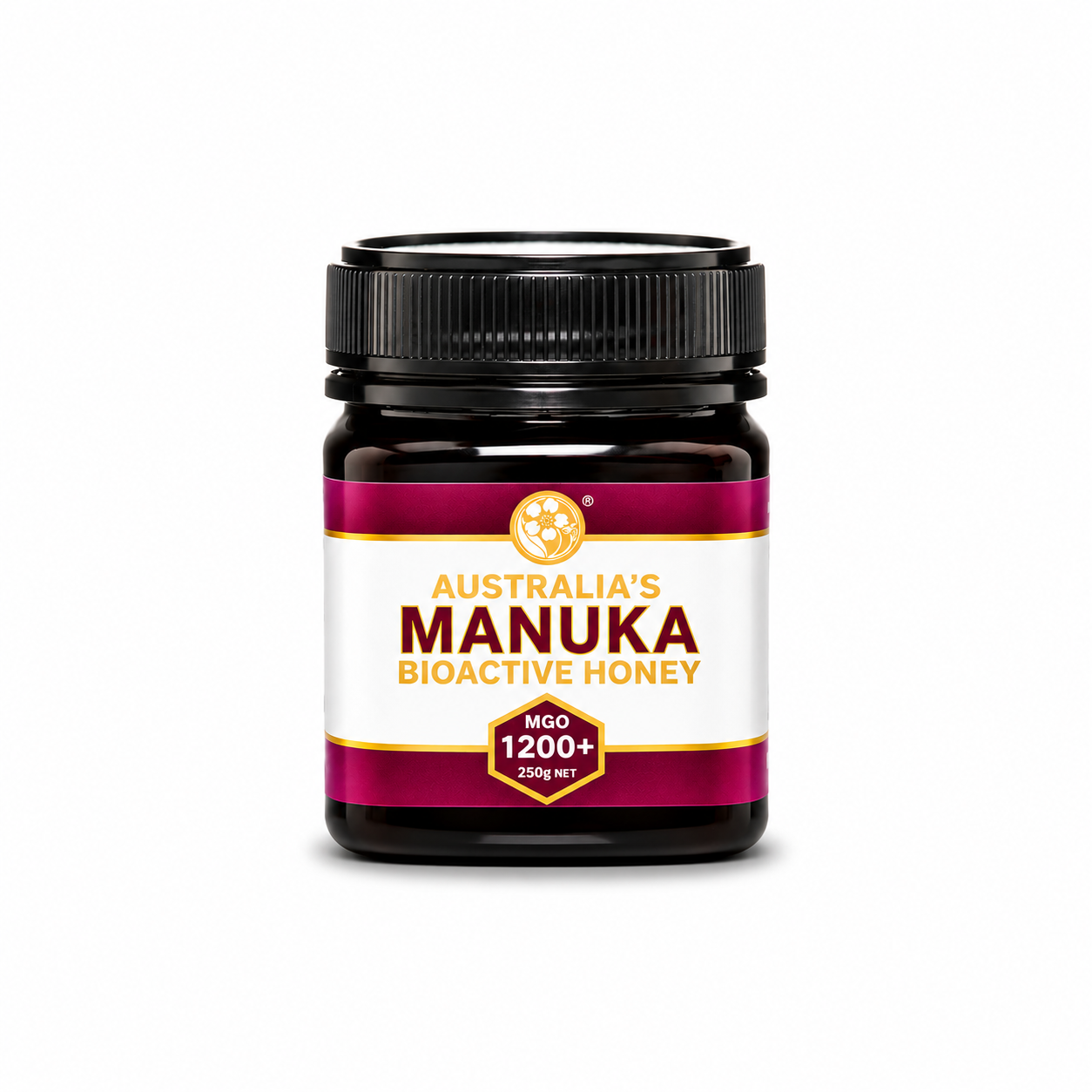
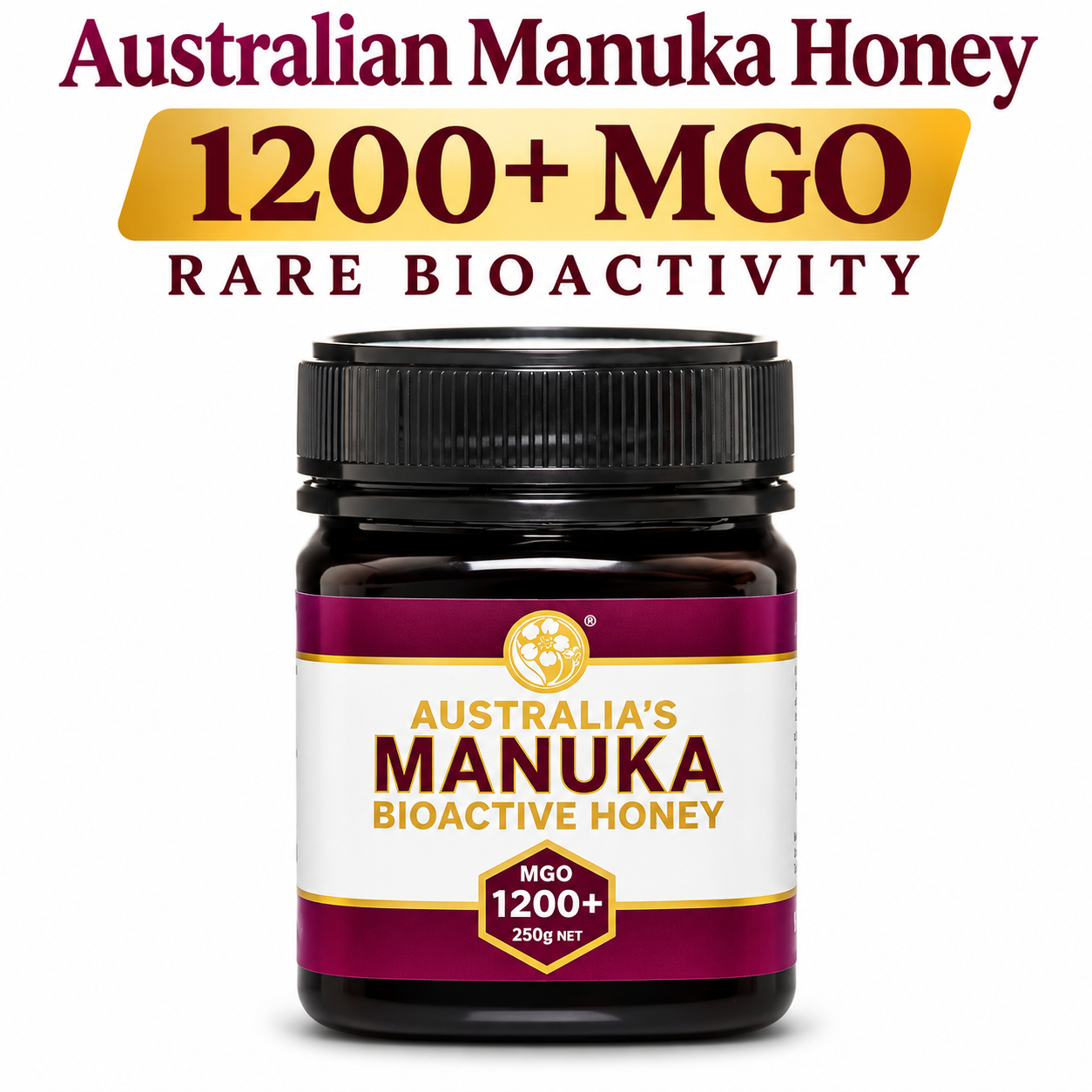
Australian Manuka Honey 1200+ MGO | Rare Bioactivity, Exceptional Purity & Premium Strength – 250g
Australian Manuka Honey 1200+ MGO Rare Bioactivity represents the extraordinary upper end of natural Manuka Honey production, delivering an exceptionally concentrated source of one of the most extensively researched compounds found in this remarkable food. At its heart is Methylglyoxal (MGO), a naturally occurring bioactive compound that develops in Manuka Honey and is responsible for much of its distinctive non-peroxide antibacterial activity. With a certified strength of 1200+ MGO, this premium honey contains at least 1,200mg of Methylglyoxal per kilogram, placing it among the more concentrated grades of commercially available Manuka Honey. Scientific research has explored MGO's ability to inhibit bacterial growth under laboratory conditions, while the honey's naturally occurring polyphenols, flavonoids and other botanical compounds contribute to its antioxidant properties. Manuka Honey has a fascinating history of traditional use and modern scientific investigation, particularly in relation to its antimicrobial characteristics and unique chemical composition. This exceptional 1200+ MGO grade offers a particularly concentrated expression of those natural properties, making it an outstanding choice for Manuka enthusiasts, biohackers and those who appreciate the remarkable chemistry of premium natural foods.
The quality of this honey begins in the pristine landscapes of Australia, where native Leptospermum plants produce the distinctive nectar from which authentic Australian Manuka Honey is created. Sourced from the Northern Rivers region of New South Wales, this rare monofloral honey reflects the remarkable botanical diversity of Australia's natural environment. Achieving an MGO concentration of 1200+ is exceptional, as the final strength of Manuka Honey is influenced by the plant species, nectar composition, environmental conditions, harvest and natural maturation processes. The honey is raw and cold-extracted, helping protect its naturally occurring enzymes, aromatic compounds and distinctive flavour profile from unnecessary heat exposure. Each batch undergoes independent laboratory analysis to verify its Methylglyoxal concentration, ensuring that its premium bioactivity rating is measurable rather than simply a marketing claim. With 100% pure Australian Manuka Honey as its only ingredient, this exceptional product contains no added sugars, artificial flavourings, preservatives or fillers. Its naturally rich colour, thick consistency and complex botanical character are the result of the honey itself, offering exceptional purity and authenticity in every jar.
For those seeking the pinnacle of premium Australian Manuka Honey, 1200+ MGO Rare Bioactivity is an exceptional choice. Its extraordinary Methylglyoxal concentration, limited natural availability and carefully verified quality distinguish it from everyday honey and lower-strength Manuka varieties. Rich, velvety and intensely flavoured, it offers a luxurious tasting experience with deep, earthy sweetness and distinctive botanical notes. Enjoy a small spoonful as part of your daily wellness ritual, savour it directly from the jar or incorporate it into cool foods and natural recipes. Whether you are interested in the science of Methylglyoxal, the antioxidant compounds found in premium honey or simply appreciate exceptionally rare and carefully sourced superfoods, this remarkable Australian Manuka delivers an outstanding combination of natural complexity, authenticity and measurable bioactivity. Discover the rare power of Australian Manuka Honey 1200+ MGO – an extraordinary expression of nature's finest honey, reserved for those who demand exceptional quality, purity and strength.
Q: Why is Australian Manuka Honey with 1200+ MGO considered exceptionally rare?
A: Achieving an MGO concentration of 1200+ requires an unusual combination of botanical genetics, nectar chemistry, environmental conditions and natural honey maturation. Not every Manuka harvest develops these concentrations, even when produced from the same geographical region. The availability of exceptionally high-MGO honey is therefore naturally limited. This makes 1200+ MGO a highly specialised grade, prized by Manuka enthusiasts who seek verified potency rather than ordinary honey sweetness.
Q: What makes 1200+ MGO Manuka Honey different from 250+, 400+ or 550+ MGO varieties?
A: The fundamental difference is the concentration of Methylglyoxal. A 1200+ MGO honey contains at least 1,200mg of MGO per kilogram, compared with 250mg in a 250+ grade or 550mg in a 550+ grade. This means 1200+ MGO provides at least 4.8 times the specified MGO concentration of a 250+ product. Higher MGO concentrations are associated with greater non-peroxide antibacterial activity in laboratory testing, although the relationship is not perfectly linear and does not establish proportionally greater benefits when consumed.
Q: What exactly is Methylglyoxal, and why are biohackers interested in it?
A: Methylglyoxal (MGO) is a small, highly reactive organic compound found naturally in Manuka Honey. It is one of the principal contributors to the honey's distinctive non-peroxide antibacterial activity. Researchers have investigated how MGO interacts with microbial proteins and other cellular components. For biohackers interested in natural bioactive compounds, Manuka Honey provides a fascinating example of how plant nectar can undergo biochemical transformation into a food with measurable laboratory activity. MGO is also produced naturally in human metabolism, where excessive concentrations can contribute to glycation, so more MGO should not automatically be interpreted as better for every biological process.
Q: Why does Manuka Honey develop MGO while ordinary honey usually contains much less?
A: Manuka nectar contains a compound called Dihydroxyacetone (DHA), which gradually converts into Methylglyoxal as the honey matures. Certain Leptospermum species produce nectar with particularly high DHA concentrations, creating the potential for unusually high MGO levels. This biochemical conversion helps explain why Manuka Honey can develop its distinctive activity after harvesting and why MGO concentrations vary substantially between batches.
Q: What role does Dihydroxyacetone (DHA) play in creating rare high-strength Manuka Honey?
A: DHA is the naturally occurring precursor to Methylglyoxal in Manuka Honey. Bees collect nectar containing DHA, and chemical reactions during storage and maturation gradually transform some of it into MGO. The initial DHA concentration, moisture content, storage temperature and maturation conditions influence how much MGO ultimately develops. High-DHA nectar is therefore an important starting point for producing exceptional 1200+ MGO honey.
Q: Is 1200+ MGO Manuka Honey significantly more bioactive than conventional honey?
A: It has a substantially higher specified MGO concentration than conventional honey, which typically contains relatively little MGO. This can translate into distinctive antibacterial activity under laboratory conditions. However, honey contains numerous interacting compounds, and its overall biological behaviour cannot be predicted from MGO alone. Its measured concentration nevertheless provides a useful, objective way of distinguishing this premium grade.
Q: What does NPA 25+ mean, and how does it relate to 1200+ MGO?
A: NPA stands for Non-Peroxide Activity, a laboratory measurement traditionally used to describe Manuka Honey's antibacterial activity independently of hydrogen peroxide. An MGO rating around 1200+ corresponds approximately to an NPA rating in the 25+ range. The two systems measure different things: MGO quantifies a chemical compound, while NPA measures antibacterial activity under defined laboratory conditions. They should not be treated as perfectly interchangeable.
Q: Why is independent laboratory testing so important for premium Manuka Honey?
A: High-strength Manuka Honey commands a premium price, making reliable verification particularly important. Laboratory analysis can quantify Methylglyoxal concentration and provide evidence that a batch meets its advertised rating. For a product claiming 1200+ MGO, independent testing offers meaningful reassurance that the strength is based on analytical measurement rather than appearance, flavour or marketing language. Ideally, testing should be traceable to the individual production batch.
Q: How can I tell whether a 1200+ MGO Manuka Honey is authentic?
A: Look for a clearly stated MGO rating, identifiable producer, country of origin, batch traceability and supporting laboratory documentation. Authenticity testing may also investigate botanical markers, pollen characteristics and other chemical indicators. A high price or dark colour alone cannot establish authenticity. Verified analytical results are considerably more meaningful than claims such as 'extra strong' or 'ultra active' without supporting measurements.
Q: Does a darker colour indicate stronger Manuka Honey?
A: Not necessarily. Honey colour is influenced by botanical origin, mineral composition, pigments, storage conditions and natural chemical reactions. Although some highly active Manuka honeys have a deep amber appearance, colour is not a reliable measurement of MGO concentration. A laboratory-verified 1200+ MGO rating provides much stronger evidence of potency than colour, thickness or taste.
Q: Is monofloral Australian Manuka Honey superior to multifloral Manuka Honey?
A: Monofloral honey is predominantly derived from a particular botanical source, while multifloral honey contains nectar contributions from several plants. Monofloral Manuka Honey is valued for its distinctive botanical character and more specific provenance. However, monofloral status alone does not guarantee higher MGO strength. The most meaningful comparison combines botanical authenticity with verified MGO concentration and quality testing.
Q: Why is Australian Leptospermum honey particularly interesting?
A: Australia is home to extensive diversity within the Leptospermum genus, including numerous native species capable of producing distinctive honeys. Differences in plant genetics, nectar composition, geography and climate contribute to considerable variation in Manuka Honey chemistry. This botanical diversity makes Australian Manuka an especially interesting subject for research into DHA, MGO development and naturally occurring honey bioactivity.
Q: Does 1200+ MGO Manuka Honey have stronger antibacterial properties?
A: High MGO concentrations are associated with substantial non-peroxide antibacterial activity in laboratory studies. Researchers have investigated Manuka Honey against organisms including Staphylococcus aureus and certain other bacteria. The results are scientifically interesting, particularly for understanding how honey behaves in direct contact with microorganisms. However, laboratory antibacterial activity does not establish that eating high-MGO honey treats infections within the body.
Q: Is 1200+ MGO Manuka Honey the same as medical-grade Manuka Honey?
A: No. High MGO strength and medical-grade status are different classifications. Medical-grade honey intended for wound care undergoes additional manufacturing controls, sterilisation and regulatory assessment appropriate to its intended use. A premium 1200+ MGO food-grade honey can have exceptional measured bioactivity without being a sterile medical product.
Q: What makes Manuka Honey's non-peroxide activity scientifically unusual?
A: Many conventional honeys exhibit antibacterial activity partly through hydrogen peroxide generated by naturally occurring enzymes. Manuka Honey is distinctive because a significant portion of its antibacterial activity can remain when hydrogen peroxide is neutralised. Methylglyoxal is an important contributor to this non-peroxide activity, giving Manuka Honey a characteristic biochemical profile that distinguishes it from many other honey varieties.
Q: Is Manuka Honey being investigated for biofilms and bacterial resistance?
A: Yes. Researchers have investigated Manuka Honey and its constituents against bacterial biofilms, which are structured microbial communities protected by an extracellular matrix. Laboratory studies suggest that certain Manuka Honey preparations can interfere with biofilm formation or microbial survival under specific conditions. This is an active area of scientific interest, although consuming Manuka Honey has not been demonstrated to eliminate established biofilms or antibiotic-resistant infections in humans.
Q: Can 1200+ MGO Manuka Honey influence the oral microbiome?
A: Laboratory research has examined Manuka Honey's activity against certain oral microorganisms, including bacteria associated with plaque formation. Its MGO content makes it an interesting subject for oral microbiology research. However, honey also contains naturally occurring sugars, and evidence does not establish that eating high-MGO honey improves the oral microbiome or prevents dental decay. It should not replace established oral hygiene practices.
Q: Why is raw, cold-extracted Manuka Honey particularly desirable?
A: Cold extraction minimises unnecessary heat exposure during processing, helping retain the honey's original aromatic profile and heat-sensitive constituents, including certain enzymes. For premium Manuka Honey, careful temperature management also helps maintain consistency and preserve the product's natural character. Raw, cold-extracted honey appeals to customers who value minimal processing and botanical authenticity.
Q: Is MGO destroyed when Manuka Honey is heated?
A: MGO is relatively heat-stable compared with many honey enzymes, but temperature and storage conditions can still influence the honey's overall chemical composition. Heating can reduce enzyme activity and alter delicate aromatic compounds. For those seeking to preserve the broadest range of naturally occurring constituents, enjoying Manuka Honey without excessive heating is a sensible approach.
Q: Does Manuka Honey contain antioxidants beyond Methylglyoxal?
A: Yes. Manuka Honey contains naturally occurring phenolic acids, flavonoids and other compounds associated with antioxidant activity. These substances contribute to its complex chemical composition alongside MGO, sugars, organic acids and enzymes. The precise antioxidant profile varies with botanical origin, growing conditions and processing, and a higher MGO rating does not automatically mean a higher antioxidant concentration.
Q: What is the relationship between Methylglyoxal, glycation and advanced glycation end products (AGEs)?
A: Methylglyoxal is a reactive carbonyl compound involved in glycation chemistry, including the formation of certain advanced glycation end products. In human metabolism, excessive endogenous MGO is associated with oxidative and metabolic stress. This is an important distinction for biohackers: the antibacterial activity of concentrated MGO in honey does not mean that consuming larger amounts improves metabolic health. The biological effects of dietary MGO are complex and remain an area of research.
Q: Can high-MGO Manuka Honey be considered a longevity superfood?
A: Manuka Honey attracts interest in longevity and functional-food communities because of its distinctive polyphenols, antimicrobial chemistry and natural botanical compounds. However, no convincing human clinical evidence establishes that consuming high-MGO honey extends lifespan or slows biological ageing. Its strongest distinguishing feature is its measurable MGO concentration and unusual honey chemistry rather than proven longevity effects.
Q: Why does 1200+ MGO Manuka Honey cost considerably more than ordinary honey?
A: Exceptional MGO concentrations are not achieved in every harvest. Producing high-grade Manuka Honey depends on suitable Leptospermum nectar, favourable environmental conditions, careful harvesting, controlled storage and analytical verification. Limited availability, specialised production and laboratory testing contribute to its premium positioning. Customers are purchasing a rare, measurable grade of Manuka Honey rather than simply a more expensive sweetener.
Q: Does higher MGO always mean better quality?
A: Higher MGO indicates a greater concentration of one important bioactive compound, but overall honey quality involves much more. Authenticity, botanical origin, freshness, moisture content, storage conditions, absence of adulteration and laboratory verification all matter. A genuine, carefully handled 1200+ MGO honey represents an exceptional combination of verified strength and premium provenance, rather than relying on MGO alone.
Q: Why choose 1200+ MGO Australian Manuka Honey for a premium daily wellness ritual?
A: This grade is particularly appealing to customers who value rare natural ingredients, traceable sourcing and measurable botanical chemistry. Its exceptionally high MGO concentration, distinctive flavour and limited availability distinguish it from ordinary table honey and lower-strength Manuka varieties. Enjoyed in modest quantities, it provides a luxurious way to appreciate one of Australia's most fascinating natural foods.
Q: Who is Australian Manuka Honey 1200+ MGO Rare Bioactivity best suited to?
A: It is an exceptional choice for Manuka collectors, functional-food enthusiasts, biohackers interested in naturally occurring compounds and customers seeking premium Australian honey with a clearly quantified MGO concentration. Those who appreciate rare botanical ingredients, independent quality testing and minimally processed foods will particularly value its distinctive provenance and exceptional 1200+ MGO rating.
NOTE: To preserve the naturally occurring enzymes and bioactive compounds in Manuka Honey, avoid heating above 40°C.
Thanks for subscribing!
This email has been registered!